
Hudson County NJ BIA Narrative Report 2025-11-04
CitizensOversight (2026-04-06) RayLutz
This Page:
copswiki.org/Common/M2052
More Info: ElectionAudits
Version 1.0, 2026-04-23. Download the PDF
Companion report: Critical Ballot Design Issues in New Jersey
Abstract
AuditEngine serves as a ballot-image auditing (BIA) platform designed to independently tabulate ballot images derived from voting systems, and compare that result with the official Cast Vote Records.
The subject of this document is an audit of the results of the 2025 General Election, Hudson County, NJ. Over 99.3% of votes were confirmed as fully consistent between the audit and the voting system.
The comparison between the results of AuditEngine and the voting system noted 919 disagreements among plain ballots which had no write-ins, overvotes, or gray flags.
The audit checked every ballot image, not a sample, by interpreting the ballot images using independent image recognition software. These are the original images created when the ballots were first scanned in the election office and could not be affected by any attacks or errors which might have affected paper ballots in storage later. Although there were no cryptographic controls on these images that would detect alterations, we had no reason to suspect such alterations.
The audit first compares complete ballots between the voting system and the results from AuditEngine. If all contests match and have no irregularities (write-ins, overvotes, or ambiguous evaluations), they are classified as "nonvariant". Otherwise, each contest on each ballot (a "ballot-contest") is considered separately.
In addition to verifying results, the audit process confirmed the accuracy of election programming, highlighted the value of consistent ballot formatting, and demonstrated how a BIA can enhance election transparency and integrity. This report provides a detailed account of findings and includes recommendations for future audits and election administration improvements.
- Abstract
- Introduction
- Records Compared
- High-Level Results
- Comparison General Explanation
- Observations
- Election system and ballot layout
- Comments:
- Turnout and Counts
- Data Counts
- Precincts, Styles, Contests
- Repeated or Improper Ballots
- Discrepancies by Contest
- Context of this Audit
- Status of this Audit
- Automated Reports
- Summary and conclusion
- Notes
Introduction
AuditEngine creates an independent tabulation of all ballots
AuditEngine is a cloud-based platform that performs an independent tabulation of votes by analyzing ballot images originally scanned by certified election system scanners. It then compares the independently derived results with the official results provided in the form of Cast Vote Records (CVRs) on a ballot-by-ballot basis. For an overview of AuditEngine’s methodology, see "Auditing Elections Using Ballot Images and AuditEngine -- General Background"1.
Not a sampling methodology
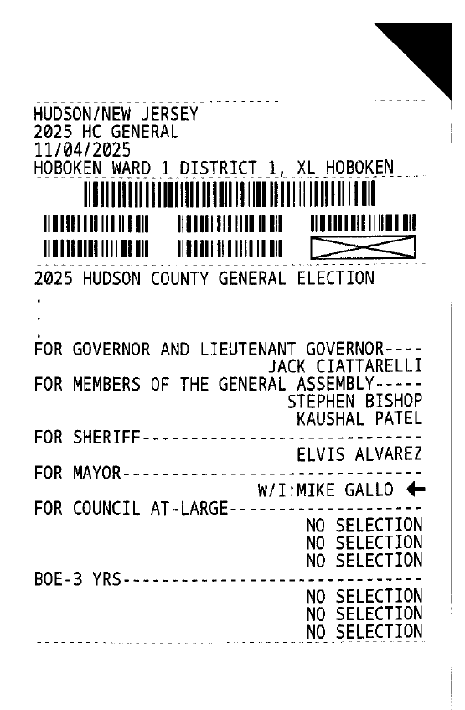
Unlike traditional audits that typically sample only a subset of ballots or ballot viewer applications that provide a user interface to look at any ballot and compare manually, AuditEngine examines every ballot image and uses image analysis to determine voter intent and create an independent complete tabulation. This comprehensive approach enables detection of discrepancies or anomalies that may go unnoticed in partial audits. It has a 0% "risk limit" as this is defined when compared with other "risk limiting" audits that audit only a few contests and allow additional risk due to sampling errors. For BMD ballots that use barcodes, AuditEngine performs OCR on the summary text and does not rely on barcodes. (About 86% of the ballots in this election were BMD ballots).
There is one more important distinction between sample-based audits -- risk-limiting audits (RLAs), for example -- and BIAs. RLAs strive to detect whether the declared winner is indeed the winner, and not whether the win should have been larger and smaller, without changing the outcome in terms of winners and losers. BIAs can detect if the win was actually larger or smaller than reported as well and other aspects of election quality that may not affect the outcome of any contest.
However, it is important to note the inherent limitations of this approach. AuditEngine cannot detect ballots that were never scanned, nor can it identify instances where fraudulent ballots may have been inserted to create matching images and CVRs.
On the other hand, ballot images may be more reliable than paper. Paper ballots may be changed when stored for a lengthy period of time.
Despite limitations, discrepancies found by AuditEngine must be taken seriously and investigated, and not dismissed without explanation. Further, we find that the configuration of AuditEngine parallels what must be done by the voting system and will frequently detect configuration errors long before the audit is completed.
Track Record
In nearly every audit conducted using AuditEngine, we have identified findings that range from minor anomalies to significant errors. These discoveries underscore the value of conducting independent, image-based audits. Audits conducted during the 2020 General Election in Florida (Volusia, Collier, and St. Lucie Counties), Georgia (Fulton and Bartow Counties), and Wisconsin (Dane County), and more recently in New Jersey, Maryland, and Colorado sometimes revealed additional ballots left in the system, thumb drives accidentally imported, and differences between the QRCode and ballot summary. These results from other jurisdictions are available at: https://auditengine.org/projects/ .
Records Compared
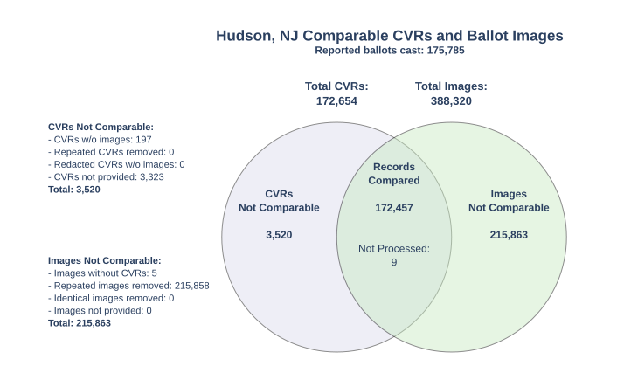
The starting point will be to understand exactly which records will be compared, and which will remain not comparable in this audit.
High-Level Results
Our Audit Report has been reduced in size and complexity by providing these simple summaries:
| Total Ballots | Hudson, NJ | %sheets |
|---|---|---|
| Total Ballots Cast (Official Report) | 175,785 | 100% |
| Ballots cast w/o CVRs | 3,131 | 1.78% |
| Ballots cast w/o Images | 3,323 | 1.89% |
Note, a nonstandard PDF was provided with results for the ballots without CVRs but it was not included in this analysis.
| CVRS | %CVRs | |
|---|---|---|
| Total CVRs | 172,654 | 100% |
| Not Comparable CVRs | 3,323 | 1.92% |
| Comparable CVRs | 172,457 | 99.89% |
| Without Matching Images | 197 | 0% |
| Compared CVRs | 172,457 | 99.89% |
| SHEET IMAGES | %sheets | |
|---|---|---|
| Total Images in Expected format | 388,320 | 100% |
| Skipped repeated Images | 215,858 | 55.59% |
| Net Unique Images | 172,462 | 100% |
| Not Comparable Images | 16 | 0.009% |
| Comparable Images | 172,446 | 99.99% |
| Full Face / Hand Marked | 23,050 | 13.37% |
| BMDs | 149,396 | 86.63% |
Comparison General Explanation
AuditEngine is not just a second voting system that tabulates the images to create independent results. A core capability of AuditEngine is its ability to perform a detailed comparison between its independent tabulation of ballot images with the official results published in the Cast Vote Record (CVR) on a ballot-by-ballot basis. AuditEngine treats every ballot-contest (a contest on one ballot) independently, and it is capable of identifying a wide range of discrepancies.
| COMPARISON | Sheets | %Sheets | Contests | %Contests | %Variants |
|---|---|---|---|---|---|
| Images and CVRS | 172,446 | 100% | 957,611 | 100% | |
| Non-variant (full sheets) | 167,484 | 97.12% | 935,015 | 97.64% | |
| Non-variants (partial sheets) | 4,962 | 2.877% | 15,655 | 1.635% | |
| Total Nonvariant Contests | 950,670 | 99.28% | |||
| Variants | 4,962 | 2.877% | 6,941 | 0.725% | 100% |
| Write-ins | 2,688 | 1.559% | 3,662 | 0.382% | 52.76% |
| Overvotes | 1,135 | 0.658% | 1,504 | 0.157% | 21.67% |
| Gray Eval. (Agreed) | 835 | 0.484% | 855 | 0.089% | 12.32% |
| Disagreed | 606 | 0.351% | 919 | 0.096% | 13.24% |
| Unprocessed Ballots | 9 |
Non-variants (full sheets and partial sheets)
Non-variant ballot-contests are those where AuditEngine and the voting system agree, with no irregularities (write-ins, overvotes, or ambiguous, i.e. "gray-eval" markings). The first set are those full ballot sheets that were fully nonvariant, and the second are sheets that had some variant contests that are treated separately.
Contest Variants
If a contest on one ballot is agreed but irregular (if it has write-ins, overvotes, or "gray" evaluations) or disagreed, it is classified as a contest variant. It is important to understand that contest variants are largely normal due to irregular ballots.
Write-ins:
Write-ins are typically very carefully reviewed by the election staff. These are generally expected and not deviations from a clean election. There are a number of cases, and these are also dependent on state law and local practice. The target may be marked or not, a valid (qualified write-in) name written or not, or a listed candidate written. Some states require that write-ins are pre-qualified.
| Write-in Situation | Initial Vote | Final Vote |
|---|---|---|
| Marked, Valid Name | WI | WI |
| Marked, Listed Candidate | WI + OV or WI | Vote for listed candidate |
| Marked, blank | WI | UV |
| Marked, Invalid Name | WI | UV |
| Not Marked, Valid Name | UV | WI |
If the contest has candidates that may be quite close, the most important type to review are the write-ins for the listed candidate. These may be initially evaluated as an overvote or as a write-in and not a vote for the listed candidate. If the listed candidate name is written in, then it is generally regarded as a common mistake by voters who believe they are expected to write in the name of the candidate they are choosing as well as marking the target, and the vote is awarded to the listed candidate. We have seen this mistake reduced in some jurisdictions if they use the wording "Or Write-in" instead of just "Write-in".
If a listed candidate is written in, a vote for that candidate is normally accepted, even if the target is not marked next to the listed candidate name.
Overvotes:
If the voting system has resolved an overvote as one or more votes or considered as a number of undervotes by the time the CVR is published, overvotes are shown in the official CVRs as undervotes for all candidates rather than as a single overvote. AuditEngine properly indicates an overvote as an overvote rather than undervotes. To avoid a plethora of contests that appear to be disagreements, AuditEngine was configured to regard these as “agreed overvotes”. Generally, undervotes are NOT regarded as a variant, as it is common for voters to not vote one or more contests and further not to vote for the full complement of allowed selections.
Gray-Eval:
AuditEngine is normally configured to attempt to use a set of heuristics and machine learning algorithms that recognize voter intent regarding overvotes. These heuristics are not perfect, but will generally recognize light hesitation marks or partial marks when paired with obvious unambiguous marks.
So for example, if an overvote consists of two ovals that seem marked, but one is very dark and the other is very light, then it may likely be the case that the lighter mark was a partial mark that should be disregarded.
In all such cases, the contests will also be marked as "gray-eval" to indicate that the evaluation of the vote required the use of heuristics, and should be further reviewed in close contests.
In addition, if the evaluation of the vote is less than certain, then AuditEngine will flag these for further review. If no CVR is available for comparison, this allows adjudication to reach a very accurate result if all gray-evals are reviewed. If the CVR is available and the comparison performed, the Gray-Eval variants may be ignored and focus on those cases where AuditEngine disagrees with the voting system.
Disagreed
The ultimate goal of the comparison is to find those cases where the voting system and AuditEngine disagree, and when the cases are not included in the other categories of Write-ins or Overvotes. These are broken down by Audit Engine into a number of separate categories. Perhaps the most interesting is labeled as x_uv, where AuditEngine determines a vote x while the voting system considers it an undervote. This can occur if the voter circled the ovals rather than filling them in, or perhaps circling the name, or marking a big X at the oval but missing it. AuditEngine uses more than one evaluation area and can frequently detect those cases.
Unprocessed Ballots
Some ballots cannot be processed due to severe image defects or alignment issues. In general, these may include:
- Torn ballots with dark wedges at the fold.
- Smudges or obstructed barcodes.
- Misfeeds that result in distorted or curved images.
- Corruption of the barcode.
- Poorly printed BMD ballots.
By handling unprocessable ballots separately, we maintain a high standard of accuracy while enabling meaningful review of edge cases. We can't include these in the total of ballot-contests because we may not know how many contests are included in these unprocessed ballots, as the source of that information is the CVR which (by rule) AuditEngine cannot accept as trusted.
In elections that are very close, we can adjudicate these unprocessable cases using the
Observations
Here are some important observations that are specific to this county and election.
Election system and ballot layout
| Attribute | Hudson County, NJ |
|---|---|
| Election System Vendor | ES&S |
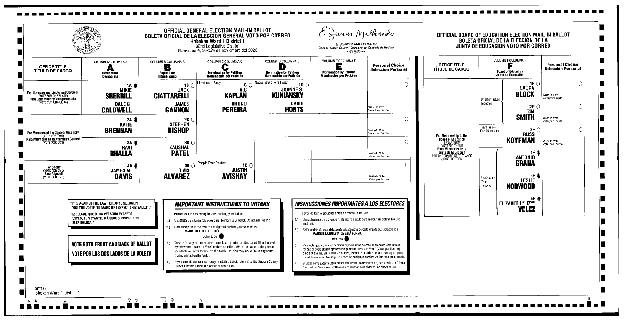
| HMB Layout | Landscape Grid: rows: contests columns: parties. |
| Oval location | Right |
HMB Layout:
Here is an example of the HMB ballot layout, on the front and back. The actual dimensions of the ballot were 8.5" x 17".
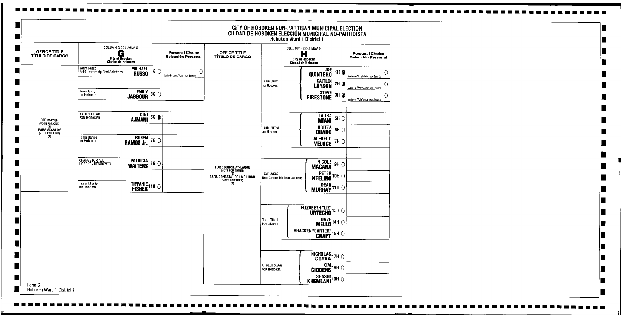
A small fraction of ballots had additional contests on the back:
Comments:
- Style Barcodes are NOT present on both sides.
In this case of ES&S ballots, the barcode is integrated into the timing marks along one long edge of the front of the ballots, but not on the back. This hinders image orientation for the back because AuditEngine must decide the rotation using text or fiducial marks within the borders of the ballot, in the active area. This could be "VOTE BOTH FRONT AND BACK OF BALLOT" or the word "Form". But this has to be set up, and unfortunately, there is no standard so it varies from case to case.
Guidelines for ballot design: In any one county, please place some text in a uniform location on all ballots on the back so the rotational orientation can be easily determined.
- Ovals to the right:
The use of ovals on the right of the ballot option name is contrary to conventional checklist design, where checkboxes typically appear on the left. This may be confusing for some voters, although it does not impair AuditEngine’s ability to correctly process and audit the ballots.
In this case, the name may be left-justified while the oval is right-justified, making the oval closer to the next option to the right. We believe left justified ovals are superior in terms of usability and also they have some advantages for avoiding conflicts from the reverse side as there are no ovals near the first column on each side, which usually are the most important contests (in a portrait oriented ballot).
- Creases near Ovals:
There are three creases evident on most hand-marked ballots. The design of the ballots results in the center crease being very close to the ovals. The creases can also disrupt recognition of the timing marks and barcodes on the front side.
To accommodate this, we added crease removal for any creases that extend the full width of the ballot and this improved performance.
- Rows are Contests, Columns are Parties:
The landscape grid design uses the same Contests in rows and Parties in columns we have seen in other elections in New Jersey, but it differs from Passaic County, which uses Parties in Rows and Contests in Columns. This makes no difference to AuditEngine but it does add one more confusion factor for voters.
BMD Ballots:
These are from an
Turnout and Counts
| Attribute | Hudson County, NJ |
|---|---|
| Population (2024) | 736,185 |
| Registered Voters (RV) | 426,483 (57.9%) |
| Reported ballots cast | 175,785 |
| Turnout of RV | 41.2% |
| Turnout of Population | 23.9% |
Data Counts
| Attribute | Hudson County, NJ |
|---|---|
| Voting System Vendor | ES&S |
| Image archives (zip) | 6 |
| CVR type | XLSX |
| Ballots Cast (per summary.csv) | |
| Gov | 175785 |
| Sheriff | 175785 |
Precincts, Styles, Contests
| Attribute | Hudson County, NJ |
|---|---|
| Precincts | 467 |
| Average Ballots cast per precinct | 376 |
| Contests | 40 |
| Styles Defined | 500 |
| Unique Contest Patterns | 24 |
| Functionally Redundant Styles | 476 |
| Ballots with no readable style | 5 |
| Small Styles Analysis (Privacy tests) | |
| Small Styles (k = 10) | 381 |
| Affected Ballots | 1624 |
| % in small styles | 0.92% |
| Split Styles with multiple precincts | 33 |
| Mergeable Styles | 361 |
| Post Merge Small styles | 20 |
| Post Merge Affected Ballots | 58 |
| Federal/UOCAVA/Prov Ballots | 1624 |
Analysis:
This county uses a massive number of ballot styles, particularly for Federal/UOCACA/Prov Ballots, 381 styles out of 500, with 119 styles apparently used for the other normal ballots.
Functionally Redundant Styles: If there are many functionally redundant styles, counties should periodically review and consolidate ballot styles to minimize complexity, reduce configuration burden, and enhance voter privacy2, particularly for styles with very low usage.
Repeated or Improper Ballots
AuditEngine routinely verifies ballot integrity by checking for repeated images and ballots from the wrong jurisdiction or election. When possible, we also extract and validate the county name and election date printed on each ballot—typically found in the header area just inside the timing marks.
| Attribute | Hudson, NJ |
|---|---|
| Repeated ballot_ids in images | 215,858 |
| Repeated Images: HMB | 0 |
| Repeated Images: BMD | 0 |
| Ballots from other Counties | All BMDs checked |
| Ballots from other elections | All BMDs checked |
Initially, there were about 35,000 images missing from the set. Hudson responded with two additional zip archives. As it turns out, one of those additional sets were superfluous as we already had all the ballots that were included in that set. Unfortunately, the software would not complete the initial parsing stage unless results from that second archive for at least one ballot would be included. To workaround this problem, we removed that archive from the list so we could continue the processing pipeline.
Additionally, there were 3,323 ballots (1.9%) that were not included in the images nor the normally formatted CVR. These were provided in a PDF report with an unusual format, which could have been used to "fill in" the records from the official CVR, so as to match the final official results. At present, we don't have that functionality, but we recognize that it would be an important capability to add, to handle those cases where they are omitted for some unknown reason (the case here), or to allow ballots to be removed from the primary set and placed into an aggregated group for privacy concerns.
This is a red flag. There should not be an additional hand-created PDF report that provides the votes for these ballots.
The missing images and then the provision of too many images and the separate report of the 3,323 ballots are a clean data violation that makes it very hard for us to fully understand the data without a lot of additional work.
This is a large number of ballots (nearly 2%) given that the closest contest was within 0.16%.
[We are willing to add the functionality to add an aggregated group to the CVR for totals comparison because of the general need, but we would need to reformat the strange PDF into an acceptable CVR-like format.
Discrepancies by Contest
While the filtering process described above provides a strong overall picture of election quality based on ballot-contests, it is essential to examine individual complete contests more closely.
A ballot-contest discrepancy count may appear insignificant in the context of the total number of ballot-contests, but in a small local contest with limited turnout, even a handful of discrepancies can be impactful. In other words, it depends on how those discrepancies are distributed across the contests. If they are all found in just a few contests, what looks like a small discrepancy may be significant.
To support this analysis, all contests are summarized in the Contest Discrepancy Report (see "Automated Reports", below), which provides detailed metrics on agreement, disagreement, write-ins, overvotes, and ambiguous marks for each contest.
By way of example for this narrative report, we focus on a subset of contests that are most sensitive to discrepancies, either due to close margins, small voter populations, or high rates of non-standard markings. These contests are the most likely to be influenced by interpretation differences and should be given particular attention in post-election review. In the overall Contest Discrepancy Report, these are highlighted if they are close in terms of their relationship to the margin of victory.
To assess the potential impact of discrepancies on individual contests, we compare the number of variant and disagreed votes to the margin of victory. If the number of all variants is less than the margin, it is mathematically impossible for the result to be reversed—even if all disagreements and variants favored the losing candidate.
Including all variants in this comparison is quite conservative, because it is quite unlikely that most variants will all benefit the reported first loser in the contest, and most variants are usually agreed write-ins and overvotes and not disagreed votes.
In practice, disagreed votes are typically split between candidates or stem from ambiguous marks, write-ins, or overvotes. For this reason, a contest generally does not become a concern unless the number of disagreed votes approaches or exceeds twice the margin of victory, which could indicate the possibility of a swing under extreme assumptions.
Here are the contests with the highest number of disagreed cases or variants. All contests can be reviewed in the Discrepancy Report.
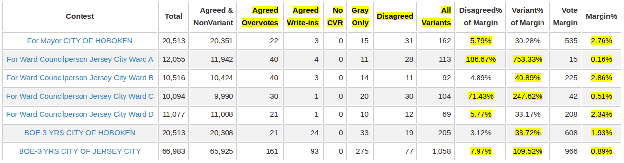
Let's look at a few examples that will also explain a few of the other aspects mentioned.
The contest with the highest percentage disagreements was the "Ward Councilperson Jersey City Ward A"
For Ward Councilperson Jersey City Ward A
- Margin of Victory: 15 votes, 0.16% of all votes cast.
- Disagreed: 28; 186.67% of margin
- Total Variants (including overvotes, write-ins, etc.): 113; 753.33% of margin
The number of outright disagreements is far more than the margin, the total number of contest variants—including ambiguous and exceptional cases—exceeds 7x the margin. For this reason, we recommend additional review of this contest, including, if deemed appropriate, adjudication of all variants using our tool,
Summary of the contest:
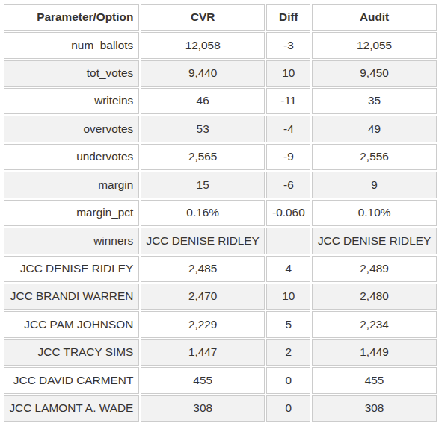
The CVR (Cast Vote Record) column provides the results per the CVR which may have some redactions. The Audit considers only those images provided, while -- when available -- the Official Results is from the file summary.csv which provides the official aggregated values (this was not available for Hudson County in this election).
We are interested in votes for Denise Ridley and Brandi Warren who are only 15 votes apart in the CVR.
Let's look at a few examples:
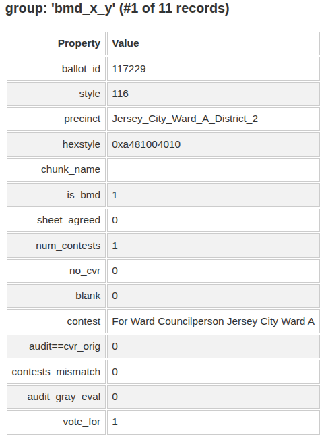
In this contest, voters can vote for one option. AuditEngine detected a vote for Denise Ridley while the voting system detected a write-in.
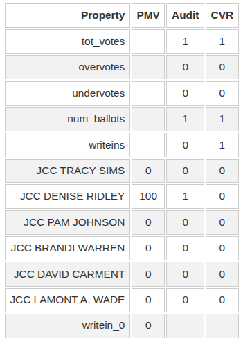
But, as it turns out, the voter wrote in the listed candidate, Denise Ridley.
Indeed, it appears we are both right. It was a write-in but it was for the listed candidate. AuditEngine simply resolved it to the listed candidate. So this should eventually be resolved if the ballots are fully adjudicated, including write-ins. Since the write-ins on BMD ballots are keyed in, there is no issue with reading it, as long as it is spelled correctly, then AuditEngine will pick up the written in name. This closes the gap somewhat from the official result.
| Candidate | Votes |
|---|---|
| Denise Ridley | 1 |
| Brandi Warren | 7 |
| Pam Johnson | 1 |
| Tracy Sims | 1 |
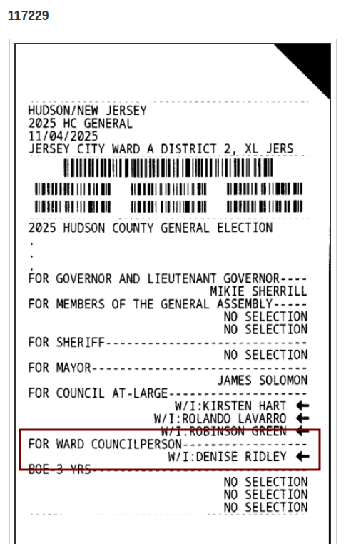
In fact all 11 cases in this category are similar in that there is a write-in for a listed candidate. Unfortunately, the CVR is pre-adjudication, and does not include any adjudications by the staff.
The next group we call "x_uv" which means that AuditEngine located a vote while the voting system believed it was unvoted. This is where AuditEngine can help to locate these edge cases.
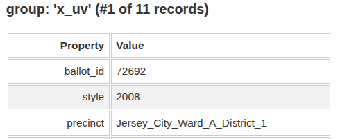
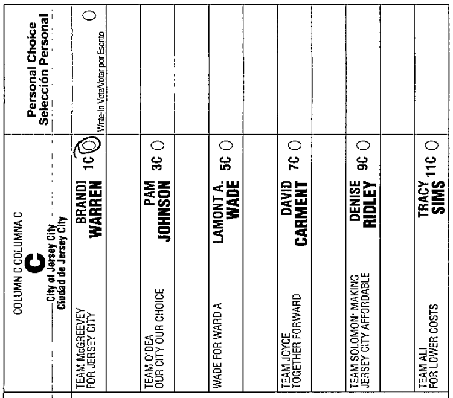
I looked over the first 10 of 11 cases, and they did not further close the gap, but widened it by 2 votes in favor of Ridley.
| Candidate | Votes |
|---|---|
| Denise Ridley | 3 |
| Brandi Warren | 1 |
| Pam Johnson | 5 |
| Tracy Sims | 1 |
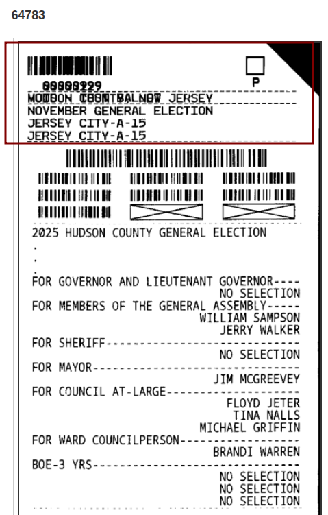
We have one ballot where we did not read a vote from the BMD ballot. It was marked by AuditEngine for further evaluation (Gray-Eval) because it appears that the reason is due to corruption of the header.
Next, we have some overvotes where AuditEngine believed they could be resolved as votes. In this first case (ballot 12766), AuditEngine used heuristics to notice that the mark for Pam Johnson was very large and could be regarded as a strike-out. This looks like the right call.
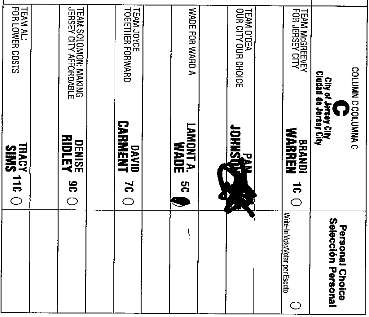
This one was regarded as an overvote but AuditEngine said it was a vote for Brandi Warren. It was an overvote, but the overvote was for a write-in with no name written, and that mark was lighter than the main mark.
ballot 11368
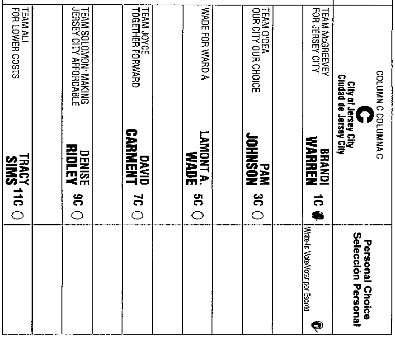
there were a few more of this type. They would be usually categorized as overvotes, and since all overvotes should be reviewed, these would be resolved by the election staff.
There were 31 write-ins that did not match a listed candidate. Even if those candidates are qualified as write-ins, there is no way they can alter the margin in this contest. But they must all be reviewed. I noticed in the first 10, there were an additional 5 votes for Warren, as WARREN, WRREN, BRANDI WARREN, WARREN.
Here is an example:
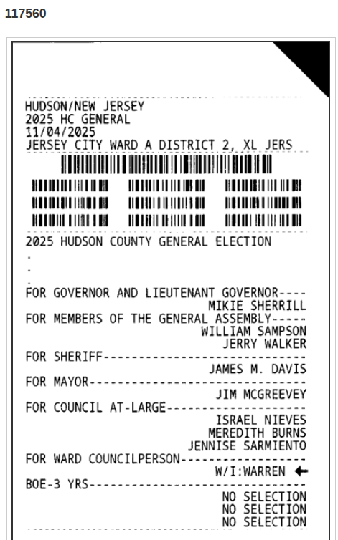
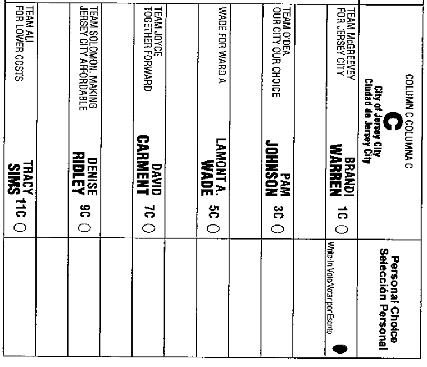
On hand-marked ballots, there were an astounding number of cases where the write-in bubble was filled in and no write-in name provided. We noticed that the write-in location is just a bit further to the right of the listed name of Brandi Warren.
The following example is typical. The question is: are people confused about how to mark their vote? Brandi Warren is next to the write-in space. Should she be awarded these votes? This is another reason the write-in location should be in the same column as the other names, not off to the side next to one name.
We did a spot check on the extra CVR file provided which had some 3323 ballots, but I could find only one vote for BRANDI WARREN, and one for DENISE RIDLEY. So these offset.
One interesting way to look at this is to start with the fully agreed results, which includes no write-ins, overvotes or "gray" votes. The margin of victory here is 2485 (Ridley) - 2468 (Warren) = 17.
The official results3 are as follows:
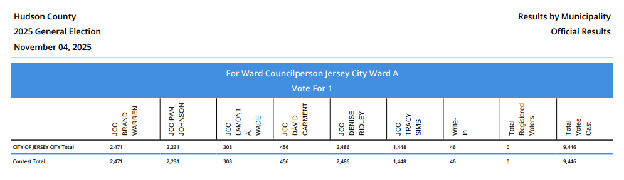
The question then becomes, in the contest variants for this contest, does Brandi Warren have enough votes to overcome that differential. Here is a quick estimate, including the official count from the website in the far right column. Notice that there were 46 write-ins listed in the official report but not that many of these should be awarded to Warren, and that the official results include 0 (zero) registered voters.
| Attribute | Agreed Votes | Exact writeins | x_uv | wi | gray | Calc. Total | Official |
|---|---|---|---|---|---|---|---|
| Total Ballots | 11,942 | ||||||
| Total Votes | 9,388 | 46 | 9,446 | ||||
| Undervotes | 2,554 | ||||||
| TRACY SIMS | 1,445 | 1 | 1 | 1,447 | 1,448 | ||
| DENISE RIDLEY | 2,485 | 1 | 3 | 2,489 | 2,486 | ||
| PAM JOHNSON | 2,228 | 1 | 5 | 2,234 | 2,231 | ||
| BRANDI WARREN | 2,468 | 7 | 1 | ~15 | 1 | 2,492 | 2,471 |
| DAVID CARMENT | 455 | 455 | 456 | ||||
| LAMONT A. WADE | 307 | 1 | 308 | 308 |
In the analysis above, we will need to manually adjudicate all 31 wi ballots. I noticed 5 in the first ten ballots so this is an estimate based on that trend. But based on this initial review and if the trend holds as shown, then Brandi Warren should have been the victor over Denise Ridley by 3 votes in the contest "For Ward Councilperson Jersey City Ward A".
We are setting up our app
There are 113 cases identified that we will need to carefully inspect.
Context of this Audit
AuditEngine independently processed and reviewed all (non redacted) ballot images, comparing the results with the official Cast Vote Records (CVRs). Raw agreement exceeded 99.3%. Despite this incredibly high number of fully agreed ballots, it appears that one contest was LIKELY awarded to the wrong candidate. Further, the official review did not review write-ins.
The audit process confirmed the accuracy of ballot configuration mappings, highlighted the value of consistent ballot formatting, and demonstrated how a BIA can enhance election transparency and integrity. This report provides a detailed account of findings and includes recommendations for future audits and election administration improvements.
Based on how marks were made for the write-in oval which was next to the Brandi Warren option, and no write-in candidate was written, we are now convinced that the grid ballot format is too confusing for continued use.
AuditEngine’s Interpretation
Unlike the CVR, AuditEngine separately identifies overvotes and write-ins by directly analyzing the ballot images. This allows for a more nuanced and accurate interpretation of voter intent. However, because the CVR omits or misrepresents these cases, AuditEngine’s results may differ for those few ballots with these characteristics.
This case is particularly important because it may be one of the first cases where we actually found a case of an outcome that was incorrect before any complaint from the community.
Status of this Audit
The main aspects of this audit and the report are complete. However, we will be continuing to investigate the possible win by Brandi Warren over Denise Ridley in "For Ward Councilperson Jersey City Ward A".
We are working to improve our reporting so it is more concise and useful for counties and any person wishing to check on their own contest results. The
Automated Reports
Hudson County, NJ
| Stage / Report | Report Description |
|---|---|
| gen_final_report Final Consolidated Report | This report provides a list of all reports available in the Audit. |
| gen_source_audit_report source_Totals_Report | This report provides a review of each contest in detail based on the ballot images in the 'source' archives. If the CVR is available when this report is created, then the totals from the CVR will be included with the difference provided. |
| gen_cmpcvr_report Discrepancy Report | This report provides details of disagreements between the voting system and the auditing result, as well as variants, such as write-ins, overvotes, and ballots which are 'gray-flagged' by AuditEngine for potential further review. This version of this report includes comparisons with the CVR, any manual results, and any adjudications. |
Summary and conclusion
The 2025 General Election audit for Hudson County, NJ demonstrates how independent Ballot Image Audits can locate improperly certified election results.
We appreciate the cooperation of the county and also local activists that were instrumental in getting the data and helping to process the audit, particularly with regard to mapping and proofing, which are manual processes.
AuditEngine successfully processed and independently tabulated every (non-redacted) ballot image, validating results against the official Cast Vote Records, with the exception of about 9 images in each case that were corrupted due barcode corruption in the image. These cases can be reviewed manually for now, but in the future, it appears that the requirement that the barcode is clear can be made optional, because the rest of the ballot appeared clear enough for the OCR algorithm to complete. The correct interpretation of the barcode is only useful for its position.
Nearly all of the discrepancies can be traced to the handling of overvotes and strike-outs.
- Suggestion: left-aligned ovals and text are more user-friendly and more like a traditional checklist.
- The grid-style ballot is unusual and we believe results in voter confusion, especially when the write-in option is to the right of only one of the listed options.
- The data had "clean data violations" because of the missing images and the 3323 cvr entries that were apparently missing.
We were able to improve and adapt AuditEngine to more gracefully handle some of the subtle differences in these data compared with other audits, such as:
- Changed barcode decoding algorithm to allow for additional bits that were added compared with prior cases from ES&S. We used additional ranges to handle these changes.
- Improved option report with option oval set to the right side.
- Improved overvote heuristics.
- Improved handling of the sanity test of corners evaluated in the image.
- Improved repair of timing marks when there is localized corruption.
- Improved crease removal when dark lines from creases.
We anticipate that as we have adapted to these subtle differences, any audit of this same county in the future will need fewer adaptations.
This audit illustrates that comprehensive image-based auditing can play a key role in election verification—detecting rare anomalies, validating system behavior, and identifying opportunities to improve ballot design and election configuration.
F......H.t.mmyT .
I.
Nh.Yyyty
.n.n
N
N
N.
.y.ynt5hhhhhhhhh
....
K.m
Hhhyngm
U. .
Yujhb.yymui
Mj
Y
Nag.
.
Uuyhh
Yu
T6u
. ..
F .nyhyyyyyuyyumimtytttjg
K
.jj
B.Y6y
Just m
Yym6
.b...h.
.
Notes
- https://docs.google.com/document/d/18A1K8mXXHnhisLqBQigx0ibboz39FAh9hOSykcR-jT4/edit?usp=sharing back
- When the public can find which voters use a style with very few ballots, they may figure out which ballot came from each person https://papers.ssrn.com/sol3/papers.cfm?abstract_id=4926979 back
- https://www.hudsoncountyclerk.org/wp-content/uploads/2025/12/2025-General-Election-Oficial-Municipality-Results-with-Contest-Level-Details.pdf back