
Critical Ballot Design Issues in New Jersey
CitizensOversight (2026-06-19) RayLutz
This Page:
copswiki.org/Common/M2065
More Info: ElectionAudits
Version 0.3, 2026-06-19. Download the PDF
This version is open for comment in the Google Doc.
Companion report: Hudson County NJ BIA Narrative Report 2025-11-04
Overview
Not all paper ballot designs are equally easy to use. Some may encourage simple mistakes. It would be best if all jurisdictions used the same format, so there would be no difference when voters move from one place to another. Just like all cars have the accelerator on the right and brake on the left. No one makes cars the other way around just for fun, as fatal accidents would surely result.
The issues outlined below will provide evidence that the format of ballots used in New Jersey, and in Hudson County in particular, are confusing and result in many forced errors. In close contests, even a few dozen honest mistakes by voters can result in elections that don't truly evaluate the will of the electorate.
Paper ballots represent a form of User Interface. It's not computerized itself, but it is the interface for computers to be able to easily read and understand the will of the voter. Unfortunately, this is not a category of voting systems that are adequately standardized by any documents such as the Voluntary Voting System Guidelines (VVSG) managed by the Election Assistance Commission (EAC), as a paper form is not considered an electronic voting system. Our view is that it is just as important to standardize these forms so they are consistently structured and no voter will have to spend time figuring out a strange format.
From our ballot image audit (BIA) of Hudson County, NJ, we found some very interesting features about the ballot design, which when combined with interpretation of voter intent, would arguably result in overturning an election result. This points out the benefits of BIAs and how they can be beneficial in detecting such issues, and also points out why we need to standardize our paper ballots.
Background
Citizens in New Jersey requested and obtained the cast vote records (CVRs) and ballot images for the November 2025 general election in Hudson County, New Jersey. We appreciate their assistance and support in enabling this Ballot Image Audit (BIA) and subsequent analysis.
We conducted a BIA using the AuditEngine system. A BIA compares the official interpretation of each ballot, as recorded in the CVR, with an independent interpretation generated from the ballot images themselves. The simplified block diagram below illustrates this process.
The voting system scans both hand-marked paper ballots and ballots generated by Ballot Marking Devices (BMD -- AKA "touch screens"). In both cases, they are scanned and then interpreted by the voting system, to create CVRs, a record for each ballot which provides the exact interpretation by the voting system, which can be summed to create the official results1.
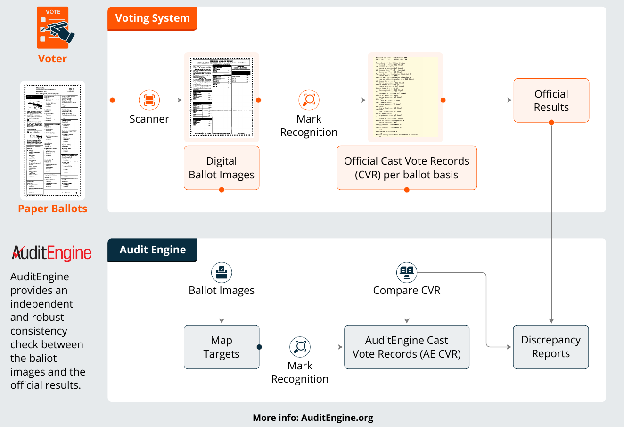
AuditEngine independently processes the ballot images to produce its own CVR-equivalent records, which are then compared with the official CVRs.
Using this process, we found that more than 97% of ballot sheets were in complete agreement between the two systems. When evaluated at the contest level, only 0.72% of contests showed any disagreement between the voting system interpretation and the AuditEngine interpretation, or may have had other irregularities, like write-ins, overvotes, and ambiguous marks. However, in close contests, even a small number of disputed ballots may materially affect the reported outcome.
This analysis focuses on one contest officially titled “For Ward Councilperson Jersey City Ward A.” The contest included 6 candidates and appeared on 12,058 ballots. According to the official results, 9,440 voters cast votes in this contest. The reported winner, Denise Ridley, defeated Brandi Warren by only 15 votes, corresponding to a margin of approximately 0.16%.
The BIA process isolates ballots requiring further review by identifying contests where AuditEngine disagrees with the official interpretation, or where the ballot includes write-ins, overvotes, or other ambiguities. For this contest, there were 113 such contest variants requiring examination.
The analysis therefore begins with the ballots where both systems agree, and then focuses on reviewing the 113 contest variants to determine the most appropriate interpretation of voter intent.
These contest variants fall into several recurring categories, which are discussed below with representative examples.
Ballot Design
Before we get into details on that contest, it is appropriate to cover the overall ballot design, which is unusual, and it turns out, is the underlying source of the issues. And before we do that, we need to dial the clock back to elections between 2003 and through 2020 in Hudson county and several others in New Jersey. After the Help America Vote Act (HAVA) was passed after the year 2000 problems in Florida, many states went to fully electronic DRE machines. In Hudson, they used the AVC Advantage which was a large panel with switches behind each grid.
(Image of AVC Advantage System)
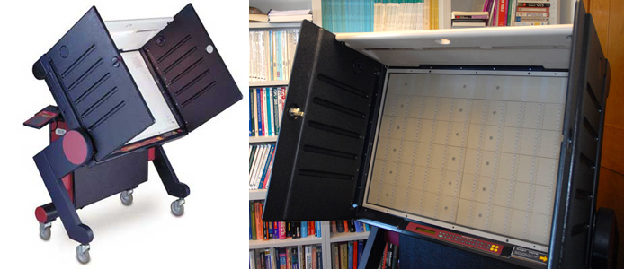
The voter would click the rectangle where the desired candidate was shown, and it would be counted for that candidate. The counting was done in a small microprocessor and there was no paper trail. Therefore, it would be easy to change the results either in the machine or much later when they were being aggregated and there was no way to check. Not at all.
Also, any sort of memory failure meant that all the votes would be lost as there was no permanent record to recount.
In 2022, Hudson County changed to the ES&S
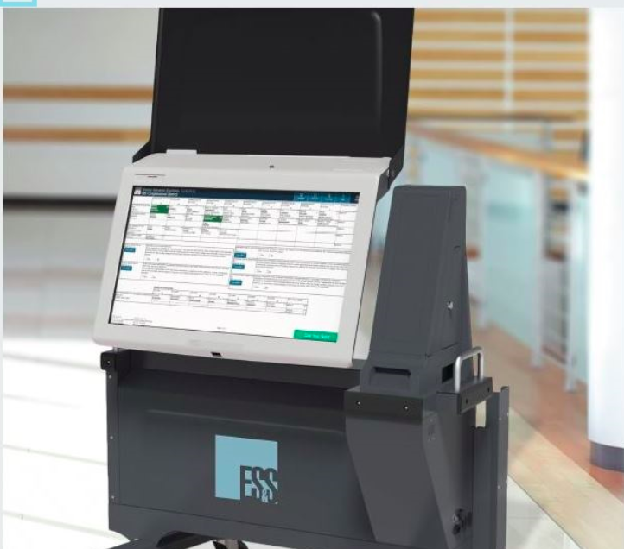
And for continuity, they wanted to use the same grid-type ballot both on the screen for in-person voting and when voters vote on paper (mail/absentee/provisional voting). But this landscape grid format is very unusual.
We must note that the
Verified Voting describes the summary card:
The
Overall Ballot Layout
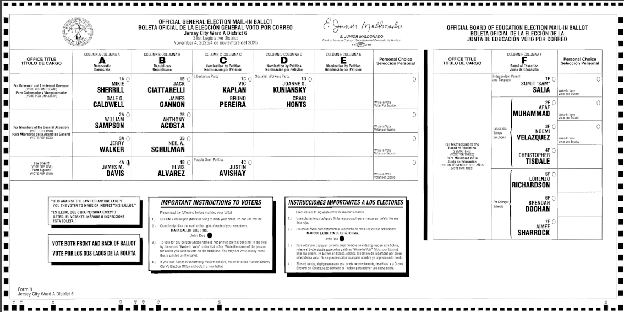
The overall layout of the ballot is a landscape orientation (wider than tall) with a grid format where contests generally run in rows while party affiliations run in columns. The vendor is Election Systems and Software (ES&S), and the style of this ballot is encoded using the differing widths of timing marks, which you can see on the bottom of the front side.
Front side
Back side 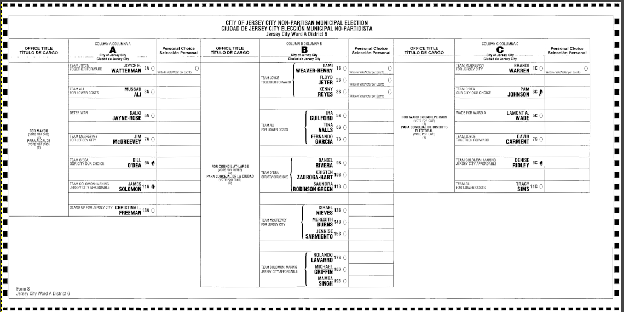
Main grid 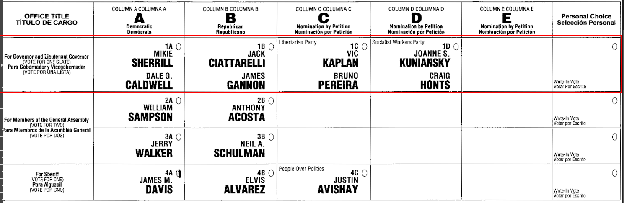
The main grid on the front places each contest in horizontal orientation, with the title of the contest to the left (in very small font) followed by candidates arranged in columns, such that if you want to vote straight-party vote you can vote down a column. At the extreme right is the write-in box. For each candidate or set of candidates, the oval is at the top right corner.
We find this is quite unusual because most places place a contest in a column with the candidates placed vertically, like a column of a newspaper, and the write-in would be at the bottom. Compared with other designs, this approach results in a number of empty boxes in the grid which wastes ballot real estate.
Contest Layout
We will be focusing on this contest on the back of this particular ballot, which is "For Ward Councilperson (Vote for One)". In this case, the list of candidates is in a vertical column but there is a single write-in box aligned with the first option "Brandi Warren". They also waste a lot of space by placing a gap between each candidate. On a ballot with typical format, in portrait orientation and with three columns about 2" wide, this would probably take less space, and be more readable as well. In that format, the write-in would be at the bottom of the column.
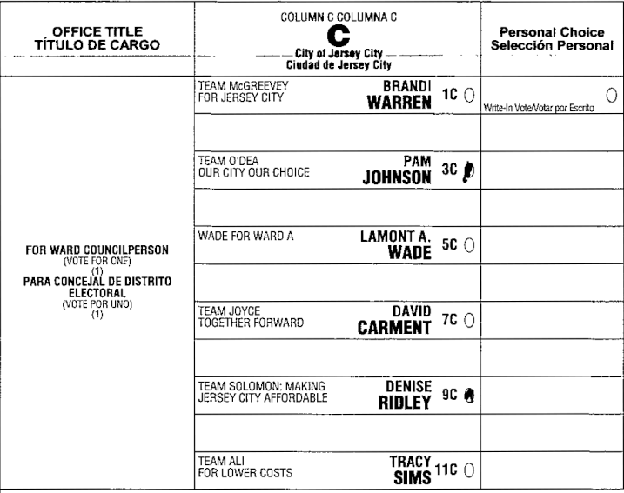
It's extremely important to note that the only write-in for this contest is to the right of the Brandi Warren option. In addition to the candidate name, they are linked to a slate using a "Team" name and a slogan.
Denise Ridley is the incumbent, which is not noted. She is linked to "Team Solomon", as James Solomon was running for Mayor, and who eventually did win the mayoral position. She won the contest by 15 votes according to the official results over runner-up Brandi Warren, linked to Team
Summary of the Contest Variants for this Contest
The following summary includes ballots where the contest appeared on the ballot but it was invalided by marking all (or nearly all) the candidate ovals, to force an overvote and invalidate the contest. These were marked "Can not count I.O." meaning "invalid office". We expect that these ballots were used for voters who were not eligible to vote on the Ward A office but it was convenient to use those blank ballots.
| Category | Warren | Ridley | Four Other Listed Candidates | Not Listed Candidate Specific |
|---|---|---|---|---|
| Listed Candidate Related | ||||
| Blank write-in with listed candidate vote | 6 | 0 | 0 | |
| Exact/inexact write-in for listed candidate | 21 | 3 | 6 | |
| Resolved undervote/overvote for listed candidates | 5 | 3 | 9 | |
| Total | 32 | 6 | 15 | |
| Suggestive but not legally resolvable | ||||
| Blank write-in marked without candidate vote but adjacent to Warren | 2 | |||
| Other Non-Candidate Related | ||||
| All other nonlisted candidate write-ins | 15 | |||
| General overvotes | 16 | |||
| Ballots with this contest but invalidated with the words: "Can not count I.O." |
27 | |||
| TOTAL | 34 | 6 | 15 | 58 |
The interpretation of ballots in this contest is governed by N.J.S.A. 19:16-3, reproduced in Appendix A, as amended in 2025. The recent amendment expands the discretion of district and county boards in evaluating ballot markings, particularly through subsection (g), which permits votes to be counted based on voter intent irrespective of the precise form or placement of the mark. This reflects a shift away from rigid, form-based requirements toward a more flexible, intent-based standard. In the context of the Hudson Ward A City Council contest, where many ballots involve machine-generated write-ins and other non-standard markings, this framework is especially relevant. Given the narrow margin of the contest and the clarity of voter intent in many of these ballots, application of the statute as amended suggests that a more comprehensive review of such ballots could materially affect the outcome.
Consistent with this statutory framework, the evaluation of ballots in this contest turns on several recurring fact patterns.
BMD write-ins matching a listed candidate.
For ballots generated by ballot marking devices (BMDs), where a voter enters a write-in that exactly or closely matches the name of a listed candidate, such entries should be treated as valid votes for that candidate. These entries reflect a clear and unambiguous expression of voter intent and do not constitute an overvote.
Marked but blank write-ins on hand-marked ballots.
For hand-marked ballots containing a marked but blank write-in, the write-in itself does not constitute a valid vote under subsection (d), which requires a written name. However, any properly marked listed candidate on the same ballot should be counted, as the blank write-in does not identify an additional candidate.
Write-ins duplicating a listed candidate (whether voted or not)
Where a voter writes in the name of a listed candidate, either alone or in combination with a marked selection for that same candidate, subsection (f) appears to invalidate the vote for that office. This provision, however, warrants careful interpretation in light of the broader intent-based framework established by subsections (g) and (h), particularly where the write-in is redundant rather than additive and the voter’s choice is clear.
From our experience across many districts, it is a common user error to write-in a listed candidate name in the write-in box, as it is not clear to many voters whether they are expected to write in the name to make sure it is clear if it ever comes up for review. We like the approach in Maryland where they use the phrase "Or Write-in" instead of just "Write-in" to indicate that it is either-or and not both, to limit this mistake.
Invalidating a vote due to a redundant name written in is a harsh and unexpected result for most voters even though it is specified in the instructions that you cannot write-in any name on the ballot. But in some rare cases, a person may legally run for two non-conflicting offices, one as a write-in.
Therefore, we suggest that subsection be revised as follows, which aligns with the other changes in this section in 2025 and will remove the current edge cases, with an intent to honor the intent of the voter:
f. If a voter marks more names than there are persons to be elected to an office, the ballot shall not be counted for that office. A write-in vote that identifies a candidate shall be counted if the voter’s intent can be reasonably determined, whether or not that candidate’s name appears on the ballot. If a voter both selects a listed candidate and writes in the name of that same candidate, or otherwise expresses the same selection more than once, the additional expression shall not be counted as a separate vote, and the vote shall be counted for that candidate. If the voter’s choice cannot be determined, the ballot shall not be counted for that office, but shall be counted for such other offices as are plainly marked.
In this case, there were actually no cases where the write-in was marked with a written-in name of a listed candidate on hand-marked ballots. But if there were, then these could still have been allowed under the 2025 revision of subsection (g), which allows for discretion if the name of the candidate is written near the listed name, and the write-in area is near the listed name for Warren.
Resolvable overvotes and undervotes.
The 2025 amendments confirm that apparent overvotes or undervotes may be resolved where voter intent can be determined. This includes cases involving non-standard markings such as circles, checks, or lightly marked ovals, which may not conform to strict form requirements but nonetheless clearly indicate a voter’s selection.
Examples of Each Category
Blank write-in with listed candidate vote
Brandi Warren had 6 of this case, where the listed candidate was voted and the write-in was also marked, but no name was written in. This can only happen on hand-marked ballots because the BMD machine will not allow a write-in to be voted without a name written in. No other candidates were both voted for, and the write-in marked, but left blank. We believe that it makes sense that the voter intended to vote for Warren in these cases, and that this is supported by the existing statute.
Exact/inexact write-in for listed candidate on BMD ballots
The layout of the user interface on this type of machine mimics the layout on full-face (hand marked) ballots. There is only one write-in voting opportunity, and it is just to the right of Brandi Warren, rather than being on-par with listed candidates and listed at the bottom of the vertical list. Thus, voters may have initially marked Brandi Warren but then pressed the adjacent Write-in button, clicked it, and wrote her name in. That would erase the initial vote for Warren and it would become only a Write-in. Although it is not apparent on the ballot summary card, the user would see the name "Brandi Warren" written in on the interactive display.
Exact write-in:

Inexact:

Resolved Undervote for Warren
Under and over votes can be resolved if the intent of the voter is clear. AuditEngine will frequently find these when the voting system does not, or vice versa, and they are flagged for further review.
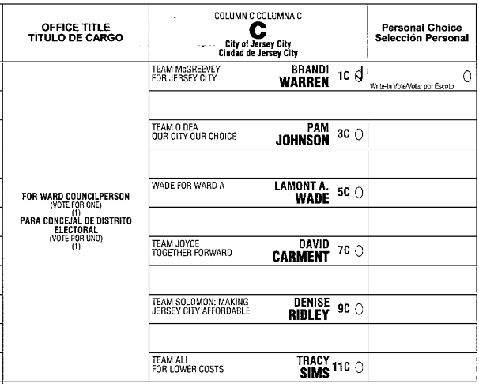
Resolved Undervote for Ridley
Here is another example where the oval is not filled at all, but the voter intent is clear. The 2025 bill clarified that these can be properly adjudicated.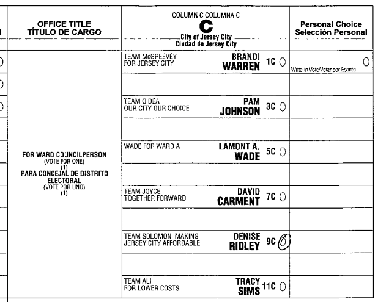
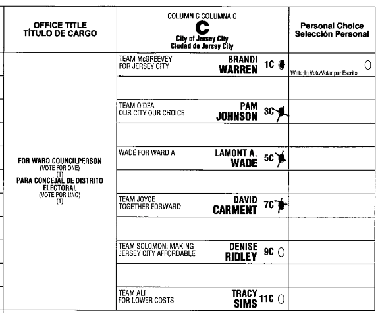
Resolved Overvote for Warren
This is a slightly more complex case where it can be interpreted that out of the four marked ovals, three should be invalidated. This case is one where it is important for the election board to use consistent rules.
Blank write-in marked without candidate vote but adjacent to Warren
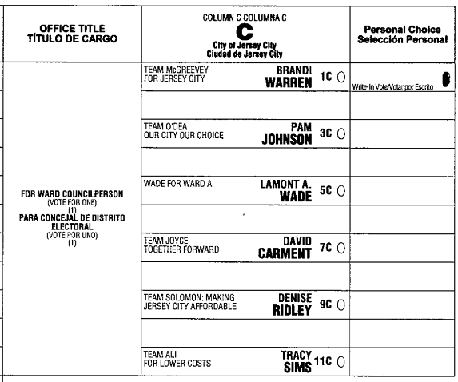
This category is not legally resolvable to a vote, but since there were 6 cases where the write-in was marked and left blank adjacent to the vote space, along with a vote for Warren (and that was not the case for any other candidate), it leads you to believe that perhaps these voters intended to vote for Warren but did not notice the first oval next to the name, and went all the way to the right.
Indeed, there is the number "1C" which is unhelpful to the voter before the oval, whereas the other oval is clearly visible.
Should this be considered a vote for Warren, given what we know about how this format can be confusing? Legally, no. But it does raise the question about why these 2 voters marked the write-in bubble and did not mark any candidate, while we see that 6 voters marked both Warren and the write-in oval, and left the write-in blank.
These 2 cases were not included in our unofficial judgment that the contest was won by Warren over Ridley due to the clear legal interpretation and obvious ambiguity, but it does appear that voters were confused here.
Findings and Recommendations
This contest provides a fascinating view of how BIAs can help reduce the number of ballots to be reviewed and focus on a limited number of contest variants that may decide a contest if they are adjudicating fairly.
Findings
-
The grid-type ballot format can be confusing to voters, particularly when write-in options are not presented in alignment with other candidate selections.
-
The ballot uses inconsistent layout conventions, with horizontally arranged contests on the front and vertically stacked contests on the back, while the write-in option remains positioned to the right of a single candidate rather than aligned with all candidates.
-
There is a clear pattern of write-in usage associated with Brandi Warren, where many entries are exact or near matches to the listed candidate name. These entries reflect voter intent and, under the 2025 amendments emphasizing intent-based interpretation, should be counted.
-
The original reported margin in this contest was 15 votes in favor of Ridley, without review of write-ins, overvotes, or ambiguous markings.
-
Under a consistent application of the statute as amended in 2025, the reviewed ballot variants would result in a net gain of 26 votes for Warren, yielding a revised outcome in favor of Warren.
-
Similar ballot layouts were used in other contests on the same ballot. While those contests were not as close, the same design issues may have affected voter behavior and vote interpretation.
Recommendations
-
Adopt a standard ballot format using portrait orientation with candidates listed vertically and a consistent placement of selection ovals.
-
Place selection ovals to the left of candidate names, consistent with statutory assumptions and common checklist conventions, and to reduce potential interference from marks on the reverse side.
-
Avoid grid-type ballot layouts that introduce unnecessary visual complexity, wasted space, and increased risk of voter confusion.
-
Ensure ballot layouts minimize the risk of bleed-through or alignment conflicts between front and back, particularly in designs where columns overlap when the ballot is flipped.
-
For BIA and other audit processes, use ballot formats that support reliable orientation and interpretation, including consistent placement of identifying features across both sides of the ballot. ES&S provides no orientation hints so a consistent word like Form can be used if it is consistent on all ballots.
-
Align write-in options with candidate selections along the same axis (e.g., as an additional candidate at the bottom of a list), rather than placing write-in areas adjacent to a single candidate.
-
Revise N.J.S.A. 19:16-3(f) to clarify that redundant write-ins for a listed candidate do not invalidate an otherwise valid vote, consistent with the intent-based framework introduced in the 2025 amendments.
-
Replace the label “Write-in” with “Or Write-in” to reduce voter confusion and discourage redundant entries for listed candidates.
-
Although not an issue on these ballots, avoid half-tone and reverse printing to allow for clear ballot images.
Conclusion
This analysis demonstrates the practical value of Ballot Image Audits (BIAs) in focusing review on a small number of consequential ballot variants rather than requiring examination of all ballots. In this contest, only 113 ballot variants required detailed review out of more than 10,000 ballots, allowing efficient and targeted evaluation of voter intent in the cases most likely to affect the outcome.
This approach contrasts with traditional audit methods such as Risk-Limiting Audits (RLAs), which are not well-suited to resolving systematic ballot design issues or recurring interpretation ambiguities. In a contest of this type, an RLA would likely escalate immediately to a full hand count without providing insight into the underlying causes of ballot discrepancies, because the margin of victory was very small. The most typical implementations of RLA audit will not escalate for down-ballot contests such as this one.
The findings also highlight the impact of ballot design on voter behavior. The grid-type layout used in Hudson County, and in particular the placement of the write-in option adjacent to a single candidate, appears to have contributed to a consistent pattern of voter confusion and redundant or ambiguous markings. These patterns are not random, but systematic, and therefore require both design and procedural remedies.
Finally, the analysis underscores the importance of aligning statutory language with modern voting systems and voter behavior. While the 2025 amendments to N.J.S.A. 19:16-3 move toward a more intent-based standard, additional clarification—particularly regarding redundant write-ins and modern ballot layouts—is warranted to ensure consistent and fair adjudication.
In a close contest, these factors may materially affect the reported outcome. More broadly, they demonstrate the need for standardized ballot design, clearer statutory guidance, and the routine use of BIAs as a practical tool for post-election review.
About the Author
Ray Lutz is the founder of Citizens Oversight and the developer of AuditEngine, a system for conducting ballot image audits (BIAs). He has conducted election data analysis and auditing across multiple jurisdictions, focusing on ballot interpretation, audit methodology, and election transparency. His work emphasizes practical, data-driven approaches to verifying election outcomes and identifying systemic issues in ballot design and vote interpretation.
References
New Jersey Statutes, Title 19, Section 19:16-3 — Counting votes; distinguishing marks; ballots improperly prepared.
https://law.justia.com/codes/new-jersey/title-19/section-19-16-3/
New Jersey Legislature. P.L.2025, c.150 (A4969) — Amendments to ballot interpretation and vote counting provisions.
https://pub.njleg.state.nj.us/Bills/2024/AL25/150_.PDF
Verified Voting. ES&S
https://verifiedvoting.org/election-system/ess-expressvote-xl/
Verified Voting. Sequoia Voting Systems AVC Advantage
https://verifiedvoting.org/election-system/sequoia-dominion-avc-advantage/
Election Assistance Commission (EAC). Voluntary Voting System Guidelines (VVSG).
https://www.eac.gov/voting-equipment/voluntary-voting-system-guidelines
Citizens Oversight. AuditEngine — Ballot Image Audit System.
https://auditengine.org/
Citizens Oversight. Narrative Report of the Ballot Image Audit of Hudson County New Jersey (2025)
https://docs.google.com/document/d/1GMFfXbBqyH2UKLfSGNTOZUTGFcBcvnn-95UxSPxF9i8/edit?usp=sharing
Citizens Oversight. Dual Tabulation Issue in ESS Voting Equipment
https://copswiki.org/Common/M1989 -- Topic page includes references, powerpoint slides and YouTube video presentation
https://copswiki.org/w/pub/Common/M1989/Dual%20Tabulation%20Issue%20in%20ESS%20Voting%20Equipment.pdf
Although the CVR can be summed to achieve the totals for each contest, voting systems don't necessarily do it that way. Early voting machines created aggregated totals for all contests available to voters at that polling location in the form of "poll tapes" which look like cash-register printouts. Later, those machines may have added support for Cast Vote Records (CVRs) which document the votes on each ballot individually. Although the CVRs are available for auditing, they are not actually summed to create the totals, as the aggregated reports from each machine are used instead.
Appendix 1 -- New Jersey Statute Regarding Vote Evaluation
URL: https://law.justia.com/codes/new-jersey/title-19/section-19-16-3/
2025 New Jersey Revised Statutes Title 19 - Elections Section 19:16-3 - Counting votes; distinguishing marks; ballots improperly prepared.
Note: Underlining indicates text added in 2025 (L.2025, c.150, s.1; A4969), approved on October 1, 2025. See full bill here: https://pub.njleg.state.nj.us/Bills/2024/AL25/150_.PDF
The 2025 amendment expands the discretion of district and county boards in interpreting ballot markings. In particular, subsection (g) introduces an internal “notwithstanding” clause that relaxes strict requirements regarding the form and placement of marks (e.g., type of mark and location within the target area), and instead permits votes to be counted based on the board’s judgment of voter intent. This reflects a shift from rigid, form-based evaluation toward a more intent-based standard.
19:16-3. Notwithstanding the provisions of any other law to the contrary, when canvassing the ballots the district board shall count the votes as follows:
a. If proper marks are made in the squares to the left of the names of any candidates in any column and the total number voted for, for each office, does not exceed the number of candidates to be elected to each office, a vote shall be counted for each candidate so marked.
b. If proper marks are made in the squares to the left of any names of any candidates in any column and in addition thereto, proper marks are made to the right of said names, a vote shall be counted for each candidate so marked; but if the district board canvassing the ballots or the county board, judge of the Superior Court, or other judge or officer conducting a recount thereof, shall be satisfied that the placing of such marks to the left and right of the names was intended to identify or distinguish the ballot, then the ballot shall not be counted and shall be declared null and void. The district board canvassing the ballots or the county board, as the case may be, shall exercise its discretion and judgment in making a determination as to whether the marks on a ballot were intended to identify or distinguish the ballot.
c. If no marks are made in the squares to the left of the names of any candidates in any column, but are made to the right of said names, a vote shall not be counted for the candidates so marked, but if the district board canvassing the ballot or the county board, as the case may be, determines, in its judgment, that the voter's intention of making the mark was to vote for the candidate whose name the mark appears to the right of, the vote shall be counted. A vote shall be counted for such other candidates as are properly marked. If the district board canvassing the ballot or the county board, judge of the Superior Court, or other judge or officer conducting a recount thereof shall be satisfied that the placing of the marks to the right of the names was intended to identify or distinguish the ballot, the ballot shall be declared null and void. The district board canvassing the ballots or the county board, as the case may be, shall exercise its discretion and judgment in making a determination as to whether the placement of the marks on a ballot were intended to vote for a candidate for election on the ballot or to identify or distinguish the ballot.
d. Where the name of any person is written or pasted in the column designated personal choice, and a cross x , plus + , or check X appears in the square to the left of the name, it shall be counted as a vote for such person.
e. In the case of any public question printed on the ballot where a proper mark is made in the square to the left of the word "Yes," it shall be counted as a vote in favor of such public question. If a proper mark is made in the square to the left of the word "No," it shall be counted as a vote against same. If no mark is made in the square to the left of either the word "Yes," or "No," it shall not be counted as a vote either in favor of or against said public question. If a mark is made in each of the squares to the left of both the words "Yes" and "No," it shall not be counted either as a vote in favor of or against the public question nor shall it invalidate the ballot.
f. If a voter marks more names than there are persons to be elected to an office, or writes or pastes the name of any person in the column designated personal choice, whose name is printed upon the ballot as a candidate under the same title of office, or his choice cannot be determined, his ballot shall not be counted for that office, but shall be counted for such other offices as are plainly marked.
g. If the mark made for any candidate or public question is substantially a cross x , plus + , or check X and is substantially within the square, it shall be counted for the candidate or for or against the public question, as the case may be. No vote shall be counted for any candidate in any column or for or against any public question unless the mark made is substantially a cross x , plus + , or check X and is substantially within the square. Notwithstanding the provisions of this subsection, if, in the judgment of the district board canvassing the ballots or the county board, as the case may be, the voter s intent in making the mark was to vote for any candidate or public question, it shall be counted for the candidate or for or against the public question, as the case may be. The district board canvassing the ballots or the county board, as the case may be, shall exercise its discretion and judgment in making a determination as to whether a vote shall be counted pursuant to this subsection, irrespective of the type of mark or its location on the ballot, provided that the mark is reasonably close to the square that would be marked to indicate a vote for any candidate or for or against any public question.
h. If a voter has written the name of a candidate reasonably close to the position occupied on the ballot by a particular office for election and has made a mark that is substantially a cross x, plus + , or check X, or written the word Yes reasonably close to the name of such candidate, the district board canvassing the ballots or the county board, as the case may be, shall count the vote for such candidate if, in the judgment of the district board canvassing the ballots or the county board, as the case may be, the voter s intent in doing so was to vote for such candidate.
Amended by L.1947, c. 104, p. 523, s. 6; L.1953, c. 19, p. 332, s. 17; amended 2025, c.150, s.1.
Notes
- See References "Dual Tabulation Issue in ESS Voting Equipment" back