
Ballot Access Lawsuit
This Page: copswiki.org/Common/BallotAccessLawsuit
Background
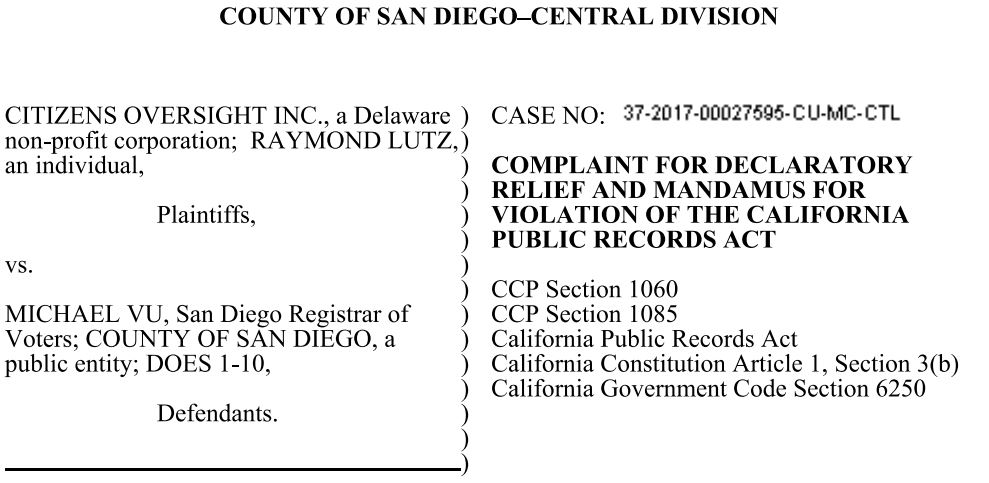
This lawsuit was filed due to our request to view ballots was denied by the Registrar of Voters, Michael Vu. The goal of this request and the first few rounds of request are found here:
We suspect possible tampering of the Early VBM ballots in the 2016 Primary election -- the only ballots where Clinton won over Sanders. All other ballot categories (polling places, Later VBM and Provisional) Sanders was the winner. Election officials must preserve the ballots for 22 months after the election. But they claim also that they are "sealed" and no one can see them. However, there is no dispute that these are public records and there is no specific exemption for voted ballots, and there is no voter-identifiable information on them. We believe the seal is only to preserve the ballots, not keep them from public review.
As of Friday, October 6:
The county responded to our complaint with a demurrer, which challenges the legal basis of our complaint. We filed an opposition to the demurrer and now we will have a hearing on Oct 13 2017, in this preliminary phase. If we win, then the case proceeds, and the county will have to respond to our complaint in full.
As of Friday, October 13
Hearing on the demurrer resulted in the court SUSTAINING it, with prejudice. That means the next step is to appeal it.
Timeline
- 2017-07-25 -- Lawsuit officially filed.
- 2017-07-31 -- Notice of similar case -- referenced ElectionAuditLawsuit.
- 2017-08-04 -- County files "DEFENDANTS' OBJECTION TO NOTICE OF RELATED CASES"
- 2017-09-11 -- County files demurrer
- 2017-09-26 -- Opposition to demurrer filed by Plaintiff
- 2017-10-12 -- Tentative Ruling (Sustaining Demurrer)
- 2017-10-13 -- Court hearing scheduled for 10:30am, Dept 66 (Hon. Kenneth J. Medel) - No changes to tentative ruling. Judge indicates he expects this to be appealed.
Documents
- Ballot Access - 2017-07-31 - Notice of Related Case
- Ballot Access - 2017-08-04 - Objections to Notice of Related Cases
- Ballot Access - 2017-09-11 - Demurrer Notice 09122017
- Ballot Access - 2017-09-11 - Demurrer Ps As Demurrer 09122017
- Ballot Access - 2017-09-11 - Demurrer Dec of Tim Barry re Demurrer 09122017
- Ballot Access - 2017-09-26 - Opposition to Dumurrer
- Ballot Access - 2017-10-12 - Tentative Ruling (which was unchanged in the final ruling)
Appeal
This case was appealed to allow the appellate court to decide if the CPRA law should allow citizens to access ballots.
- Appeal of BallotAccessLawsuit-AppelateCase-D073522.pdf: Initial filing of Appeal of Ballot Access Lawsuit, Appellate Case: D073522
- Appellants Opening Brief FINAL.pdf: Appellants Opening Brief, Appellate Case: D073522
- Respondents Brief-1.pdf: County Response to the Appeal
- Appellants Reply Brief.pdf: Appellants Reply Brief, Appellate Case: D073522
- D073522-Citizens Oversight vs. Vu CT Vol 1of1.pdf: Clerk's transcript of Ballot Access Lawsuit case
- Motion for Judicial Notice.pdf: Judicial Notice in Ballot Access Lawsuit appeal
- D073522_Opinion.pdf: Opinion of the Appellate court affirms that ballots are not accessible
Appeal to CA Supreme Court
We are preparing an appeal to the CA Supreme Court due to obvious mistakes in the appeal.
Prop 59 of 2004 made disclosure of public records a constitutional amendment.
https://en.wikipedia.org/wiki/2004_California_Proposition_59
Similarly, it strengthens the case for access in cases where, under existing statutory exemptions, records can be withheld when the public's interest in non-disclosure clearly outweighs the public's interest in disclosure.\[4\] This is so because most interests in non-disclosure are not constitutionally based and thus will be of significantly less importance when weighed against a now-constitutional right of access.
Election code 15154 concerns whether ballots are rejected for personal information, and they are not:
- (a) Any ballot that is not marked as provided by law shall be rejected. The rejected ballots shall be placed in the package marked for voted ballots or in a separate container as directed by the elections official. All rejected ballots shall have written on the ballot the cause for rejection and be signed by a majority of processing board members who are assigned by the elections official to process ballots. - (b) The following ballot conditions shall not render a ballot invalid: - (1) Soiled or defaced. - (2) Two or more impressions of the voting stamp or mark in one voting square. - (3) Contains personal information, as defined in Section 14287 . - (c) If a voter indicates, either by a combination of both marking and writing in, a choice of more names than there are candidates to be elected or nominated for any office, or if for any reason the choice of the voter is impossible to determine, the vote for that office shall not be counted, but the remainder of the ballot, if properly marked, shall be counted. - (d) This section applies to all ballots counted pursuant to this chapter and Chapter 4 (commencing with Section 15300 ).
Election Code 14287 defines personal information
No voter shall place personal information upon a ballot that identifies the voter. "Personal information" includes all of the following: - (a) The signature of the voter. - (b) The initials, name, or address of the voter. - (c) A voter identification number. - (d) A social security number. - (e) A driver's license number.
SB 183, Correa. Ballots: identifying information. (2011)
http://leginfo.legislature.ca.gov/faces/billTextClient.xhtml?bill_id=201120120SB183
Existing law prohibits a voter from placing any mark upon a ballot that will make the ballot identifiable. Under existing law, a ballot that is not marked as provided by law or that is marked or signed by the voter so that the ballot can be identified by others is required to be rejected. If a ballot is marked in a manner so as to identify the voter, the ballot is required to be marked "Void" and placed in a container for void ballots. This bill would instead prohibit a voter from placing personal information, as defined, upon a ballot that identifies the voter. The bill would provide that a ballot that contains personal information is not invalid. The bill would delete the requirement that a ballot marked in a manner so as to identify the voter is void and instead require a ballot that contains personal information to be segregated in a specified manner and would require that a duplicate ballot be prepared. By adding to the duties of local elections officials, the bill would impose a state-mandated local program. The California Constitution requires the state to reimburse local agencies and school districts for certain costs mandated by the state. Statutory provisions establish procedures for making that reimbursement. This bill would provide that, if the Commission on State Mandates determines that the bill contains costs mandated by the state, reimbursement for those costs shall be made pursuant to these statutory provisions. SEC. 4. Section 15208 of the Elections Code is amended to read: 15208. (a) Each container of ballots shall be opened and its contents removed. The ballots shall be checked to ascertain if the ballots are properly grouped and shall be arranged, if necessary, so that all similar ballots from the precinct are together. (b) Any ballot that contains personal information, as defined in Section 14287, or is torn, bent, or mutilated shall be segregated in the manner directed by the elections official and a duplicate shall be prepared as provided in Section 15210.
---> THUS, Ballots are not supposed to have any personal identifiable information when stored for 22 months. ---> There are no privacy issues that are respected if the ballots are indeed processed according to these laws.
The opinion by the Apellate Court included a reference to the "right to privacy":
Our Constitution also provides all Californians with a right to privacy. (Cal. Const., Art. 1, § 1.) It provides, specifically, that "Voting shall be secret." (Cal. Const., Art. 2, § 7.) The privacy of the vote is a well-established social norm. (Chantiles v. Lake Forest II Master Homeowners Assn. (1995) 37 Cal.App.4th 914, 924.) Voters reasonably expect that their personal voting decisions will not be known to others. (Ibid.)The CPRA balances the tension between open access to governmental records and the constitutional right of privacy. It sets forth broad rules for access to public information, with exemptions that protect certain privacy rights. The Legislature has declared that, "access to information concerning the conduct of the people's business is a fundamental and necessary right of every person in this state," but it was also "mindful of the right of individuals to privacy." (Gov. Code, § 6250.) In light of this balance, the CPRA exempts from disclosure those public records that are expressly protected by statute (Gov. Code, § 6254, subd. (k))3 and other categories of information when balancing openness and privacy interests. (Gov. Code, §§ 6254--6254.33; City of San Jose, supra, 2 Cal.5th at p. 616; Chino, supra, 30 Cal.App.5th at p. 536.)
And here:
New York has no common-law right of privacy and its Constitution protects privacy only against state action. (Arrington v. New York Times (Ct.App. 1982) 55. N.Y. 2d 433, 440, 443.)
But there is no threat to the right to privacy as there is, by statute, no personally identifiable information on voted ballots in storage.
Direct link to this page: http://copswiki.org/Common/BallotAccessLawsuit
Summary of articles submitted for this project:
- M1969 2021-05-28 Maricopa County Audit -- 2020 General Election -- RayLutz CitizensOversight

 M1947 2020-07-07 Letter to Gov. Newsom to include all ballots in the audit -- RayLutz CitizensOversight
 - CitizensOversightStatusUpdate2019 2020-04-13 Citizens Oversight Status Update 2019 -- RayLutz CitizensOversight
 M1892 2019-03-10 Election Integrity Update -- Ray Lutz -- RayLutz CitizensOversight
 - CitizensOversightStatusUpdate2018 2019-02-09 Citizens Oversight Status Update 2018 -- RayLutz CitizensOversight
- M1868 2018-08-01 Election Audit Fraud Supreme Court Petition - Conf / Livestream -- RayLutz CitizensOversight
- M1843 2018-06-07 Court Hearing on 2016 Primary Contest - Motion to dismiss by County -- RayLutz CitizensOversight
- M1840 2018-05-07 Letter to Michael Vu regarding 2018 election season and oversight -- RayLutz CitizensOversight
- M1835 2018-03-20 Ray Lutz appears on Real Progressives Roundtable -- RayLutz CitizensOversight
 M1830 2018-03-07 Election Integrity Update -- Ray Lutz on Facebook live -- RayLutz CitizensOversight
 - CitizensOversightStatusUpdate2017 2017-12-20 Citizens Oversight Status Update 2017 -- RayLutz CitizensOversight
- M1806 2017-12-18 Ex Parte Meeting on Contest -- RayLutz CitizensOversight
- M1793 2017-10-13 Court Hearing to Access Ballots in 2016 Primary -- RayLutz CitizensOversight
- M1782 2017-07-30 Man sues county so he can personally recount last year's election votes -- JoshuaStewart UnionTribune
- M1781 2017-07-28 Press Conf: Lawsuit Filed to Allow Ballot Review -- RayLutz CitizensOversight
- M1735 2017-03-19 Early VBM Discrepancies in San Diego 2016 Primary -- RayLutz CitizensOversight
- SanDiegoPrimaryContest2016 2017-02-02 San Diego Primary Contest 2016 -- RayLutz CitizensOversight
- M1658 2016-06-16 Lutz vs. Vu -- Complaint for Declaratory and Injunctive Relief -- Ray Lutz, Alan Geraci CitizensOversight
Discussion List
See ListServe for all email discussion lists and to add more. %KEYWORDTOPICLISTSERVE%